

ChicTravel vs. Wanderlog: Which Trip Planner Is Right for You?
Both turn a messy pile of ideas into a clean day-by-day itinerary. We break down where each one wins — collaboration, maps, budgets, and the AI that does the planning with you.

If you've outgrown a Google Doc and a dozen open browser tabs, you've probably landed on the same two names: ChicTravel and Wanderlog. Both take the chaos of planning a trip — flights, hotels, that restaurant a friend swore by — and turn it into a clean, shareable, day-by-day plan. They overlap more than either would admit.
So instead of crowning one overall winner, we'll go category by category, talk through each one honestly, and call a winner for that round. We'll be upfront: this is our blog, so we have a favorite. But Wanderlog genuinely wins some of these, and we'll say so.
Round 1: The AI planning assistant
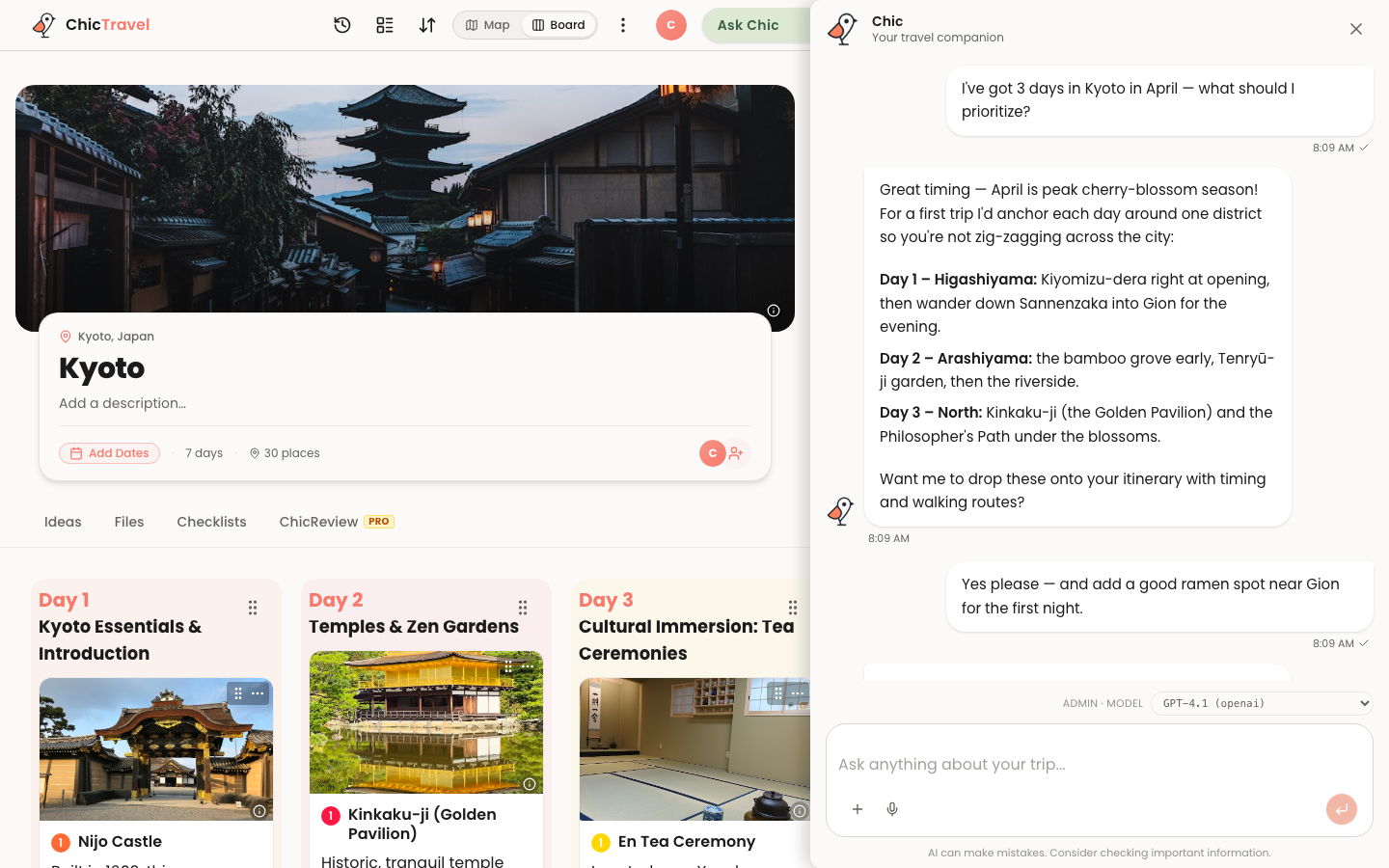
ChicTravel is built around Chic, an AI copilot you actually talk to. "Plan five days in Kyoto for foodies," and you get a real itinerary in seconds — then "swap day three for something rainy-day friendly," and it reshapes on the spot. The assistant isn't a sidebar feature here; it's how you build and edit the whole trip.
Wanderlog has added AI suggestions too, and they're useful for surfacing ideas. But they sit alongside a mostly manual builder rather than driving it. If you want planning to feel like a conversation where the app does the heavy lifting, this round isn't especially close.
Round 2: Connecting to Claude
Here's something no other mainstream planner offers: you can connect ChicTravel directly to Claude. Add it as a custom connector and Claude can create trips, read your itineraries, and drop notes onto any day — all from a normal chat, with edits showing up live in your trip.
If you already plan by talking to an AI, your travel organizer now lives right inside that conversation instead of in yet another tab. Wanderlog has no equivalent, so this one's a walkover.
See how the Claude connector works →Round 3: Real-time collaboration
Both apps let you plan with other people, but the feel is different. ChicTravel uses real-time sync, so when your travel partner reorders day two or adds a dinner reservation, you see it happen — no refresh, no "who has the latest version." It's closer to editing a doc together than passing a plan back and forth.
Wanderlog supports shared trips as well, and it works fine — but for group trips where everyone wants a say at once, that live immediacy keeps the planning from stalling. ChicTravel edges this round.
Round 4: Importing reservations from email
Credit where it's due — this is Wanderlog's signature trick, and it's excellent. Forward a confirmation email and it parses the hotel, flight, or restaurant booking and drops it straight onto the right day, times and all. It saves a real amount of copying and pasting.
ChicTravel leans on its AI and manual entry for this rather than inbox parsing. If automatically pulling bookings out of your email is central to how you plan, Wanderlog clearly wins here.
Round 5: Offline mobile apps
Wanderlog's native iOS and Android apps are mature and fully offline-capable — which genuinely matters when you're standing in a foreign train station with no signal and need your itinerary. It's a polished on-the-road experience.
ChicTravel is a fast, mobile-friendly web app, great for planning and very usable on a phone, but it doesn't match a dedicated offline-first native app on the trip itself. Wanderlog takes this round.
Round 6: Road trips and route optimization
For big multi-stop road trips, Wanderlog's route optimization and driving-time and mileage estimates are genuinely handy — it'll help order your stops and tell you how long each leg takes.
ChicTravel draws routes between your stops on the map so you can see the shape of a day, but it doesn't optimize stop order or estimate mileage for a cross-country drive. Road-trippers should give this one to Wanderlog.
Round 7: Maps and itinerary view
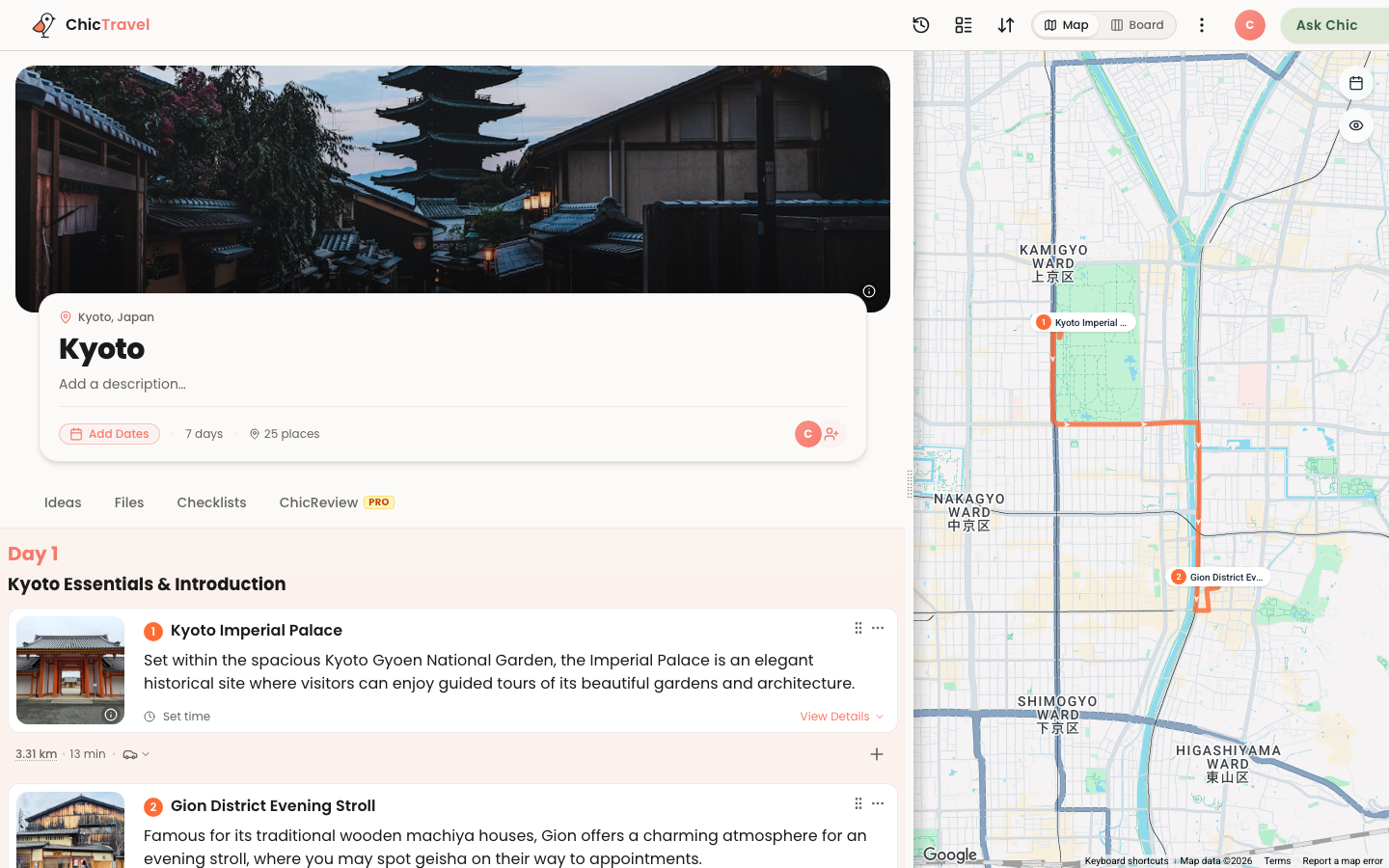
Both do this well. ChicTravel plots every place on an interactive map with routes drawn between your stops, so you can immediately spot when day four has you crisscrossing the city. The day-by-day itinerary is clean and drag-to-reorder.
Wanderlog's map and itinerary views are equally strong and well-loved. Honestly, neither pulls ahead here — this round is a wash.
Round 8: Budgets and expenses
ChicTravel includes trip budgets to track what you're spending, plus checklists and file attachments for tickets and confirmations. Wanderlog offers solid expense tracking too, with the ability to log and split costs.
Both cover the essentials well enough that most travelers won't feel a gap on either side. We're calling this one even.
Round 9: Shareable, copyable guides
This is a ChicTravel favorite with no real Wanderlog equivalent: publish any trip as a public guide, and other travelers can browse it and copy the whole thing into their own account as a starting point.
It's a lovely way to share the Lisbon long-weekend you nailed — and a great way to begin your next trip from someone else's hard-won itinerary instead of a blank page. ChicTravel wins this round comfortably.
Round 10: The pre-trip safety net (ChicReview)
ChicReview is a ChicTravel Pro feature that reads your finished itinerary and flags what's missing before you leave — an unbooked hotel night, no way to get from the airport, a museum you've scheduled on the day it's closed, a document or visa you haven't sorted.
Wanderlog gives you checklists, which are handy, but nothing that actively inspects your plan for gaps and tells you what to fix. An AI that audits the whole trip for you has no Wanderlog equivalent.
Round 11: Taking your plan to any AI
ChicTravel Pro can export the full trip context — everything Chic knows about your itinerary — as a file you can hand to another AI tool, share, or keep for your records. Paired with the Claude connector, it makes ChicTravel unusually open to AI-driven planning.
Wanderlog keeps your trip locked inside Wanderlog; there's no way to pull the structured context out for use elsewhere. Another one with no equivalent on the other side.
Round 12: A dark theme, for free
ChicTravel ships a proper dark theme anyone can switch on for free — far easier on the eyes when you're planning a trip late at night.
Wanderlog has no dark mode at all, so it's a bright white screen at midnight whether you like it or not. A small thing, but a free one ChicTravel simply has and Wanderlog doesn't.
Round 13: Pricing
Both are free to start and let you plan a real trip without paying a cent. Wanderlog's free tier shows ads and gates a few extras behind its paid plan; ChicTravel is free forever on the basics, no credit card required.
ChicTravel Pro is $39.95 a year with a 3-day free trial, bundling the ChicReview audit, PDF export for a polished trip packet, calendar export to an .ics file for Google, Apple, or Outlook Calendar, and AI context export. Wanderlog's paid tier has its own perks, like its standout reservation parsing.
For most travelers planning a trip or two a year, either free tier is plenty — so on entry-level value, it's a tie.
So which should you choose?
If your planning is mostly logistics — importing bookings and carrying them offline in a polished mobile app — Wanderlog earns its reputation. If planning is a creative, collaborative, back-and-forth process, ChicTravel was built for exactly that: an AI copilot that plans with you, a Claude connector that meets you where you already chat, real-time collaboration, and shareable guides. The good news is that both have free tiers, so the honest advice is to plan your next trip in each and let the one you keep coming back to win.

